El Salvador’s Bitcoin Decision Is About to Launch
About two and half months ago, El Salvador, with a population of 6.9 million in Central America, came to the fore of the crypto money and finance world through the statements of President Nayib Bukele announcing that he would accept Bitcoin (BTC) as a legal currency. That proposal was quickly approved, thanks to President Bukele’s party’s having the majority of the seats in parliament. The date that the proposal would be in effect was determined as September the 7th. As of September 7, all the businesses in El Salvador will have to accept payments in Bitcoin. While we have two weeks just before the proposal will be put into effect, as well as what happened right after El Salvador’s Bitcoin decision, the other countries affected by the upcoming trend have been probed; within the article, you will also find the thoughts of El Salvador people about the Bitcoin decision.
Remittances
Since El Salvador is not an economically developed country, it has many citizens working in countries with developed economies such as the USA, like many South and Central American countries do. Currently, these people working abroad regularly make remittances to El Salvador banks to send their families money. According to World Bank statistics, 24% of El Salvador’s total income comes from those money transfers. In other words, a quarter of the entire country’s income comes from abroad. The outstanding issue here is the remittance commissions collected and the last but not least, maybe even more importantly, the integration of El Salvador into the global banking network. According to the statistics, 70% of El Salvadorans do not have access to the global banking system. President Bukele’s statement that El Salvadorans abroad can easily send money to the country shows that the Bitcoin decision was taken primarily just for this purpose, considering all those data.
Bitcoin allows much faster and cheaper money transfers than banks do while doing international money transfers. If El Salvador’s Bitcoin decision was not taken just with the intention of advertisement or benefit and is really intended to ensure El Salvadorans’ use Bitcoin in their daily lives; then we can argue that the opportunity of cheap and secure money transfer provided by Bitcoin will facilitate the start of transformation by replacing remittances. For the transformation to start completely, the amount to be sent from abroad should at first be converted into BTC and thus the transfer should be made in BTC, the transferred amount should be kept as BTC by El Salvador citizens and used as BTC in shopping. However, though BTC has steadily gained value in the long term and during its life span to date, it can be quite volatile on daily basis. Therefore, Salvadorans receiving the money in BTC are more likely to quickly convert BTC to USD. This, especially in the early stages, is regarded as one of the most important obstacles against the possibility of increasing the use of BTC in daily life.
Wallet and Stablecoin Initiatives
Since El Salvador officials too considered the possibility of BTC not being used in daily life due to its volatility, thus the country’s own wallet application Chivo was created and introduced to the public. At the same time, that the government has plans to create a stablecoin is understood through an interview with President Bukele’s brother. On the other hand, when all the pieces are put together, it becomes clear that many factors must come together for Bitcoin to get a wide area of use in daily life. Once the infrastructure is fully established, a Salvadoran user will be able to keep the amount he receives in BTC in his wallet by converting it to the country’s own stablecoin (for the time being USDT, USDC, or DAI only) via the wallet application Chivo, which he/she gets access to through his/her phone. As for during shopping, payment can be fulfilled by converting the desired amount into BTC with an instant transaction. Creating wallets and stablecoins will take a significant length of time for the government. However, considering that the country’s infrastructure is not developed enough and there is even no internet access in some regions, it turns out that the time that the process will take is not the most important problem. Therefore, El Salvador has investments to make and important subjects to take into account for fully complete integration.
Mining
El Salvador has many active and passive volcanoes. For that reason, energy production in an environmentally friendly way is presently possible through geothermal energy facilities in the country. It is known that President Bukele instructed the state-owned company operating the geothermal plant to allocate some of the plant’s resources for Bitcoin mining. Considering that decision of Bukele, it can be both said that he tempted the mining companies on investment by arousing their appetite and that he kept pace with the trend of Bitcoin production through renewable energy, which started with the immigration of miners to the USA. But El Salvador should not be considered an energy-rich country simply looking at geothermal energy. The country imports 25% of the electricity it needs from the surrounding countries.
The Protests
Although there has been quite a positive atmosphere within the cryptocurrency community after the government’s decision on Bitcoin, it has also been observed that the El Salvadorans have not managed to reach a full consensus and that they are worried if the already expensive electricity prices will increase further with the arrival of Bitcoin mining in the country.
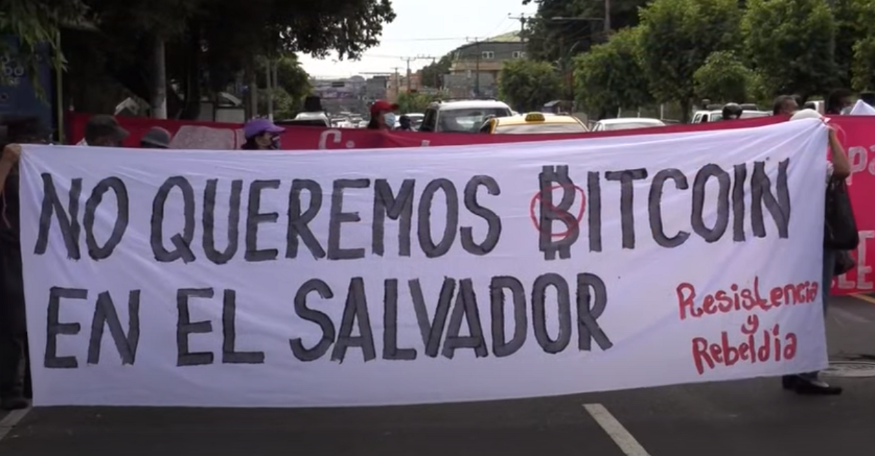
To elucidate the citizens on the issue, Francisco Gavidia University organized a survey in the capital San Salvador; 1233 people were asked several questions about the Bitcoin decision, and important findings were obtained.
- 77% of the public did not esteem the government’s Bitcoin decision as making sense. Only 19.4% supported the decision, implying to find it sensible.
- 61% of the business owners stated unwillingness to be paid with Bitcoin and 64% of the citizens did not want to receive salary with Bitcoin.
- Perhaps the most surprising result is that only 5.4% of the citizens receiving the money from abroad by remittances said they preferred to receive that transfer as BTC. 82.8% of the citizens stated the preference to receive remittances in USD. The underlying reason for this answer may be the concern that once the transfer arrives in BTC, the conversion process to USD may be difficult and costly. As mentioned in the above sections of the article, El Salvador still has investments to make in this regard. Another possibility is that the public is uninformed on BTC.
- While 95% of the public thought the USD to be beneficial in terms of financial stabilization of the country, the percentage of those who thought the BTC to be beneficial in this sense was only around 1%.
Looking at the survey results up to this point, it is clearly seen that the public does not lean towards the Bitcoin decision in general. Starting out from this point, it is perceived that El Salvador’s Bitcoin decision is a step taken depending on the individual preferences of President Bukele and his government rather than being a natural trend result as a consequence of the societal needs and demands. The fact that the consultation process was not carried out during the decision-making process also supports this idea.
On the other hand, the fact that the public is against the Bitcoin decision does not necessarily mean that the government’s decision is definitely wrong or right. We will be able to comment on this by looking at the results in the following years. However, the reluctance of the public to use Bitcoin seems to be the biggest obstacle for the process to function healthily.
We observed from the above results that the public was generally against the decision and came to a conclusion that the decision was taken with Bukele’s own initiative. Now, let’s examine the Bukele and system-related questions in the same survey and the answers from the citizens:
- 33% of the public thinks that the reason for Bukele to take the Bitcoin decision originated from his personal interests.
- 40% of the public thinks that the Bitcoin decision will benefit only large companies, and only 13% think that it will bring positive consequences for the country in general.
- Bukele announced that the government would allocate a fund and that the payments received by the businesses in BTC could be transferred to their accounts in USD, to facilitate the widespread use of Bitcoin by the public and to facilitate the Bitcoin/USD conversion. In other words, he explained that businesses had to receive payments in Bitcoin, but they did not have to transfer the payments to their accounts in BTC. In the survey, 33.9% of the participants stated to have understood the explanation, 20% did not understand, and 44% did not even watch the broadcast. The survey is quite important in terms of revealing both the indifference of the public to the subject and their lack of financial literacy.
- It cannot be just said that there is not a wide awareness yet, not only in terms of financial literacy but also in the Bitcoin context. The participants aged over 65 who took part in the survey stated the Bitcoin to be a metallic currency, those who aged between 30–55 stated to be either a metallic currency or virtual currency, and those aged between 18–29 stated it to be a virtual currency. These data may be esteemed normal by the standards of many countries but considered as a very low level of awareness for the people of a country that has made Bitcoin a legal currency.
Finally, the lawsuit filed by the opposition party for the annulment of the Bitcoin decision is important as it is a different example for the protests. In case the opposition party wins the case, it may be impossible for now to experience one of the most important practices in Bitcoin history.
If we leave aside the possibility of self-interest or similar considerations of Chairman Bukele; and start out from the assumption that he aims at the country’s transformation, we face an indisputable fact that Bukele not only carried out a critical test for global finance but also made an important commercial move. With the government allocating some of its geothermal energy to Bitcoin mining, the revenue from mining could pay for both the electricity Bitcoin consumes and a part of the imported electricity. More importantly, the acquired Bitcoins can be used as security deposits in centralized and decentralized financial institutions, thus giving the government access to extra credit resources. At the same time, the El Salvador government can offer the credit system in return for Bitcoin collateral to its own citizens. Considering that a Texas-based mining company acquires a daily income of 2 million USD through 30,000 mining devices, it can be expected that El Salvador will also have a significant income with the investments it will receive and through its own mining investments. In case that happens, the negative feedbacks in the survey will likely change in the opposite direction.
El Salvador Wind
It is observed that after El Salvador’s Bitcoin decision, news on similar studies began to emerge from surrounding countries as well; for example, congress members/senators of various countries made some statements and offered proposals, probably because they had only advertising value. On the other hand, it can be argued that none of these proposals achieved serious success by becoming legalized as in El Salvador.
Meanwhile, the opinions conveyed from various global financial institutions regarding El Salvador are also noteworthy. Both these organizations’ and countries’ views and studies are summarized below.
Organizations
- After Bukele announced his decision on Bitcoin, there have emerged thoughts that the country’s negotiations with the IMF, during which loan negotiations are being conducted, could be jeopardized. The IMF expressed its concerns that the decision might cause macroeconomic, financial, and legal problems and announced that they would discuss the issue with President Bukele. Soon after, JPMorgan also expressed the opinion that the Bitcoin decision jeopardized the talks with the IMF.
- Together with the IMF and JPMorgan, Benoit Coeure, the President of BIS, the international banking authority, commented that El Salvador’s decision was an “interesting experiment”, stating that they, as BIS, regarded Bitcoin as a speculative investment tool that needs regulation rather than being a currency.
- The World Bank has announced that it would not provide any support to El Salvador regarding the Bitcoin decision, as well.
- Soon after the above negative opinions, the Central American Bank for Economic Integration made an important statement supporting the Bitcoin decision by announcing that it would send a team to provide technical support to El Salvador.
- The rating agency Fitch stated that as a result of El Salvador’s Bitcoin decision, businesses were being forced to choose one of two options; the first one was to reserve BTC in their balance at the end of the payments, while the second was to immediately convert the payments received in BTC into USD. It was stated that businesses choosing the first option, namely reserving BTC, would experience a lowering in their credit scores due to the volatility of Bitcoin, and their risk scores would be bumped up by insurance companies.
Countries
- Senator Eduardo Murat Hinojosa in the Mexican Federal Government announced that a bid to kick off Mexico’s Bitcoin adaptation would be placed. However, there has not been any new development after that. (June 8)
- Panamanian Congressman Gabriel Silva announced that he was carrying out a study for the domestic adoption of Bitcoin and its acceptance as a currency. (June 16)
- Paraguayan Congressman Carlos Rejala has prepared a proposal to turn Paraguay into a Bitcoin-friendly country, not by accepting Bitcoin as a currency, but through the completion of various regulations.
- Juan Sartori, a member of the National Party, one of the coalition parties in Uruguay, presented a law proposal that includes various regulations and licenses allowing Bitcoin to be used as a legal payment tool and to be traded within the country. The proposal does not envision Bitcoin as the legal currency of the country as in El Salvador but aims to ensure its domestic use by integrating Bitcoin into the present legal infrastructure.
- Argentine President Alberto Fernandez stated that he was not against the use of a country’s own digital currency (CBDC) or Bitcoin within the country and saw no reason to reject the idea. The President also added that Bitcoin can be used as an important hedge tool against inflation. Argentina has been struggling with economic difficulties due to inflation in recent years. Bitcoin’s ever-increasing value over the long term makes it an attractive reserve to offset inflationary economies. Nevertheless, the Argentina Central Bank’s governor stated that Bitcoin was not a real financial instrument and did not produce permanent profitability, thus he did not have the same ideas as the President.
US Taxes (IRS)
Unlike the examples above, El Salvador’s Bitcoin decision may not have many pleasant consequences for US citizens, leading to some changes in the Bitcoin classification of IRS (Internal Revenue Service). Because the IRS has been classifying Bitcoin as a property since 2014 and taxing it within this scope. The tax rates for persons owning BTC for more than a year are further deducted thanks to this classification. The reason why Bitcoin was classified as a commodity and not a currency was that it did not meet the currency standards that the IRS has been adhering to. These standards are being provided by the recognition, use, and crediting of the relevant commodity by a sovereign authority after El Salvador’s decision. This thus shows that there may be unpleasant surprises in taxation for BTC investors in the future.
For BTC investors, FinCEN (Financial Crimes Enforcement Network), which is responsible for investigating money laundering and terrorist financing in the USA, requires that the relevant commodity is used as a medium of exchange within the country where the money is printed. Look at it with the eye of both the IRS and FinCEN, Bitcoin now seems to have the qualifications that meet the currency standards after El Salvador’s decision. Because it is being accepted by a sovereign authority and the way for it to be used as a means of exchange within the country is being paved. In addition, the minting requirement which the FinCEN firmly sticks to can be met through the mining activity of Bitcoin.
Former IRS Senior Advisor, Roger Brown, says that the IRS accepts the definition of “minting activity” in the strict sense, that is, the printing of money directly by the Mint itself, for this reason, El Salvador’s Bitcoin mining is quite unlikely to be recognized by the IRS as minting. Brown also states that he does not think that El Salvador’s acceptance of Bitcoin as a sovereign authority will make much sense to the IRS, but he says that this matter will likely change only if the main actors such as the EU or many small countries accept Bitcoin. Although there seems to be the possibility that the IRS shift to change the definition of Bitcoin, Brown states that yet this probability is low. However, if there will be a significant increase in the tax revenues of the IRS as a result of this regulation, both El Salvador can be considered as a respected authority and Bitcoin mining can be interpreted under the definition of “minting”.
As a result, the date of September 7 does not just mean that El Salvadorans will wake up to a Bitcoin day, but it has also taken its place on the calendar as a date that might cause significant changes for the Americans as well. Although it is not known in what direction the negative opinions of other countries and organizations will change, it can be said that if El Salvador earns a considerable income through Bitcoin, the possibility that the country progresses to become the first “Bitcoin Country” then can be quite strong. The developments either on or beyond September 7 should be watched very closely, as they may represent the steps that a very small country will take in the way of changing perhaps the entire global financial system.
Prepared by: Berkay Aybey
The opinions and comments expressed here belong to BV Crypto. BV Crypto cannot be held responsible for any financial transactions made on the basis of this post. Every investment and trading move involves risk(s). When making your decision, you should do your own research.

Berkay Aybey
Business Analyst